
How Much Is Your In-Home Care Agency Worth? 6 Things That Drive Its Value

Most in-home care agency owners aren't planning to sell their business tomorrow.
Maybe not next year, either.
But whether you're one year, five years, or 10+ years away from a potential sale, there's value in understanding one question:
What would someone actually pay for my agency today?
And maybe the more important question is:
What could I do now to make it worth more later?
We recently had the opportunity to talk through this with a group of experienced in-home care franchise owners. Most weren't actively preparing to sell. They simply wanted to understand what creates value and what they could be doing now to keep their options open.
And that's an important distinction.
You don't have to be preparing to sell to start building a more valuable business.
The decisions you make today around profitability, cash flow, reporting, growth, management, and operations can affect the value of your agency years from now.
How Is a Home Care Agency Valued?

There is no single formula that tells you exactly what an in-home care agency is worth.
A buyer may consider profitability, growth, risk, geography, management, payer mix, revenue concentration, deal structure, and many other factors.
But two common valuation approaches can give owners a starting point.
1. Revenue Multiple
For smaller in-home care transactions, a rough working range we sometimes see discussed is approximately:
0.50x–1.00x annual revenue
For example, an agency generating $4 million in annual revenue might initially look something like:
$4,000,000 × 0.75 = $3,000,000
2. Normalized ODP Multiple
Another approach is to value the business based on normalized owner earnings, or ODP.
A working range might be approximately:
3.5x–5.0x normalized ODP
If an agency produces $800,000 of normalized ODP:
$800,000 × 4.25 = $3,400,000
These examples are illustrative starting points, not hard-and-fast valuation rules or guarantees of what a buyer will pay. Actual transaction values can vary significantly based on profitability, growth, risk, market conditions, owner involvement, payer mix, deal structure, and other factors.
The bigger question is:
Why would one agency receive a 3.5x multiple while another receives 5x?
That's where things get interesting.
Same Revenue. Very Different Value.
Imagine two home care agencies that both generate $5 million per year.
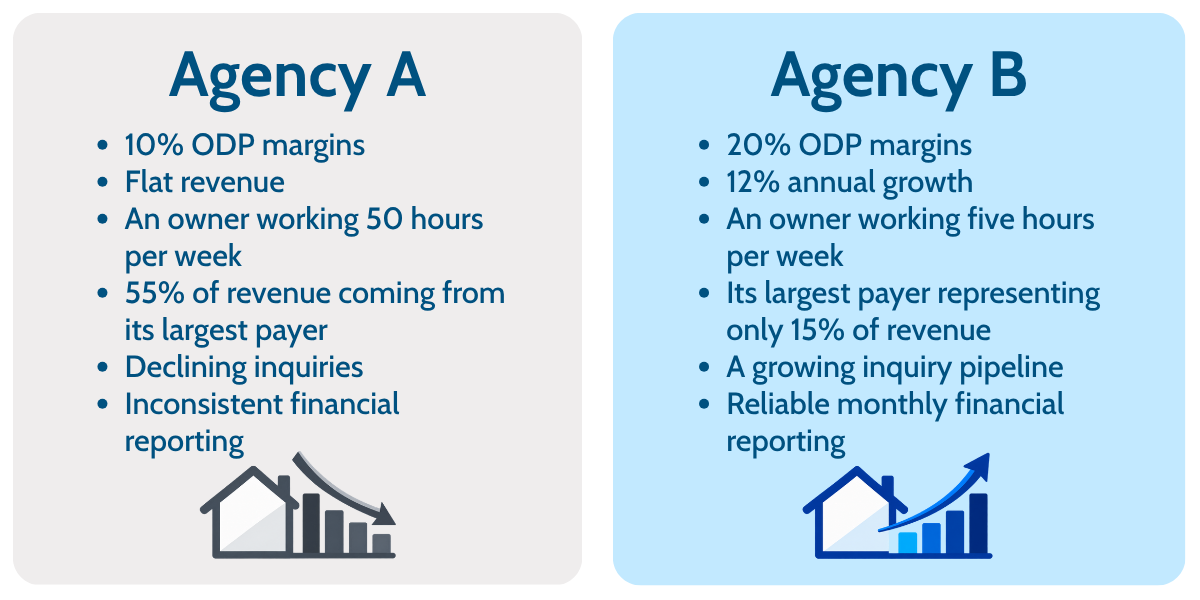
Both are technically "$5 million agencies."
But they aren't the same quality of business.
A buyer isn't simply purchasing last year's revenue.
They're trying to determine how reliably the business can produce cash flow after the current owner leaves.
That's why agency valuation ultimately comes down to several major areas.
1. Financial Performance and Reporting
Revenue matters.
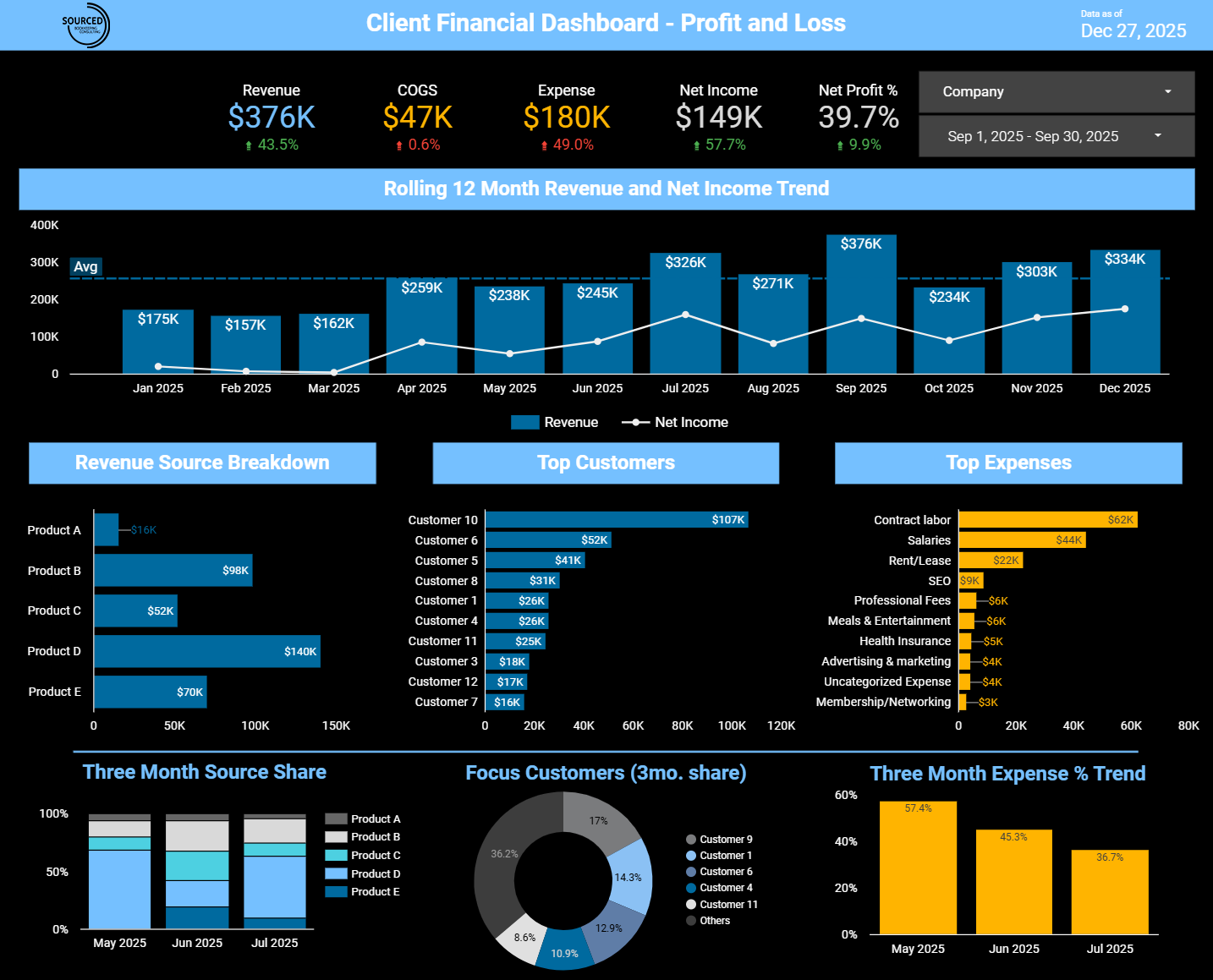
But profitability matters too.
A buyer will likely want to understand things like:
Revenue trends: Is revenue growing, flat, or declining?
ODP or EBITDA margin: How much money does the agency actually generate?
Gross margin: Are rates keeping up with caregiver wages and other direct costs?
Accounts receivable: Does the company actually collect what it bills?
Financial reporting: Can someone trust the numbers?
Clean books probably won't make someone dramatically overpay for your company.
But messy books can absolutely make them question it.
Consistent monthly financial reporting also gives owners and potential buyers a clear history of the business's performance. It makes it easier to understand the trends behind the numbers instead of relying on a snapshot of the most recent month.
For an owner, accurate financial reporting isn't just about knowing what happened. It's about being able to identify problems, understand profitability, and make better decisions before those problems become more expensive.
2. Revenue Quality and Payer Concentration
A $5 million home care agency with diversified revenue is different from a $5 million agency that depends heavily on one payer, client, referral source, or government program.
That doesn't mean government revenue is inherently bad.
VA, Medicaid, and other programs can be meaningful and profitable parts of an in-home care agency.
The issue is concentration risk.
If a large percentage of your revenue depends on one contract, reimbursement structure, renewal decision, or payer relationship, a buyer will likely view that concentration as a risk that needs to be evaluated.
We'd look at things like:
Largest client as a percentage of revenue
Largest payer as a percentage of revenue
Government vs. private-pay mix
Largest referral source
Client retention
Recurring vs. less predictable revenue
Generally, the more diversified and predictable the revenue is, the stronger the business becomes.
3. Marketing and Lead Generation

One often-overlooked part of valuation is understanding where the next clients will come from.
A buyer shouldn't just ask:
"How much revenue did you generate?"
They should also ask:
"How do you generate the next dollar of revenue?"
That means understanding numbers like:
Monthly inquiries → assessments → new clients
Where are those inquiries coming from?
What percentage convert?
How much does it cost to acquire a new client?
Are inquiries increasing or declining?
Is the agency dependent on one salesperson or one referral relationship?
An agency with a measurable, repeatable growth engine is very different from one where the owner simply says, "We've always been good at getting referrals."
A strong marketing pipeline gives an owner greater visibility into future growth and gives a potential buyer a better understanding of how the agency generates new business.
4. Territory, Market Potential, and Growth Opportunity
Especially in a franchise system, the territory itself can be part of the value.
A buyer may look at:
Current senior population
Growth in the 65+, 75+, and 85+ populations
Household income
Private-pay opportunity
Geographic density
Current market penetration
Untapped areas within the territory
Competition
Adjacent growth opportunities
Buyers are paying for today's cash flow.
But they're also evaluating tomorrow's opportunity.
An agency generating $3 million in a territory with significant remaining growth opportunity may tell a very different story than an agency generating $3 million in a territory that is already highly penetrated.
Market opportunity doesn't automatically translate into value, but it can help a buyer understand the agency's potential for future growth.
5. How Dependent Is the Business on You?
This may be one of the most important questions an owner can ask:

If I disappeared for 30 days tomorrow, what would break?
Would clients call you?
Would recruiting slow down?
Would your referral partners stop hearing from anyone?
Would payroll, billing, scheduling, or financial reporting suffer?
Would your leadership team know what decisions to make?
There is nothing inherently wrong with an owner being heavily involved in their company.
But from a valuation perspective, there's a difference between buying a business and buying a job.
The less dependent the company's results are on the current owner, the easier those results are to transfer to a buyer.
Building a leadership team, documenting important processes, and creating systems that allow the business to operate without constant owner involvement can make the agency more scalable today and more transferable in the future.
6. Know Your Normalized ODP
This is another area where owners can get themselves into trouble.
Your tax return or P&L may show one level of profit, while the normalized earnings of the business tell a different story.
There may be legitimate adjustments for things like:
Owner compensation above market
Personal vehicle expenses
Personal travel
One-time legal expenses
Truly nonrecurring projects or costs
But there's another side to the equation.
If the owner currently acts as CEO, salesperson, recruiter, or general manager, a buyer may need to hire someone to replace those responsibilities.
That cost needs to be considered too.
The goal isn't to make profitability look better on paper. It's to arrive at a realistic picture of the earnings a buyer could expect from the business after accounting for the costs required to operate it without the current owner.
For example:
Reported net income: $500,000
+ legitimate adjustments/add-backs: $190,000
– replacement management cost: $120,000
Normalized ODP: $570,000
The key is that an add-back has to survive buyer scrutiny.
Simply calling something "discretionary" doesn't make it disappear.
Small Improvements Can Have a Big Impact on Value
This is where valuation becomes especially relevant even if you have no plans to sell.
Suppose you sustainably improve annual ODP by $100,000.
At a 4.0x multiple, that could theoretically represent approximately:
$100,000 × 4.0 = $400,000 of additional value
That assumes the improvement is sustainable and the applicable valuation multiple remains the same.
That's why pricing decisions, wage management, administrative efficiency, payer mix, and expense management aren't just about this month's P&L.
Over time, they can become enterprise-value decisions.
Growth Matters. But the Quality of Growth Matters More.
Owners naturally focus on revenue growth.
And growth is important.
But consider two agencies.
One grows 20%, but:
Margins decline
The owner works more
Payer concentration increases
Caregiver turnover gets worse
Accounts receivable grows
Another grows 10%, but:
Margins improve
Management gets stronger
The inquiry pipeline improves
Payer diversification increases
The owner becomes less essential
Which company would a buyer likely view as the stronger business?
Revenue is important.
Healthy, repeatable, profitable growth matters more than growth for growth's sake.
If Selling Is on Your Radar
You don't need to wait until you're ready to sell to start preparing.
The amount of preparation you need will depend on your timeline, but the underlying goal is the same: build a business that can demonstrate consistent financial performance, operate without excessive owner dependence, and give a buyer confidence in its future.
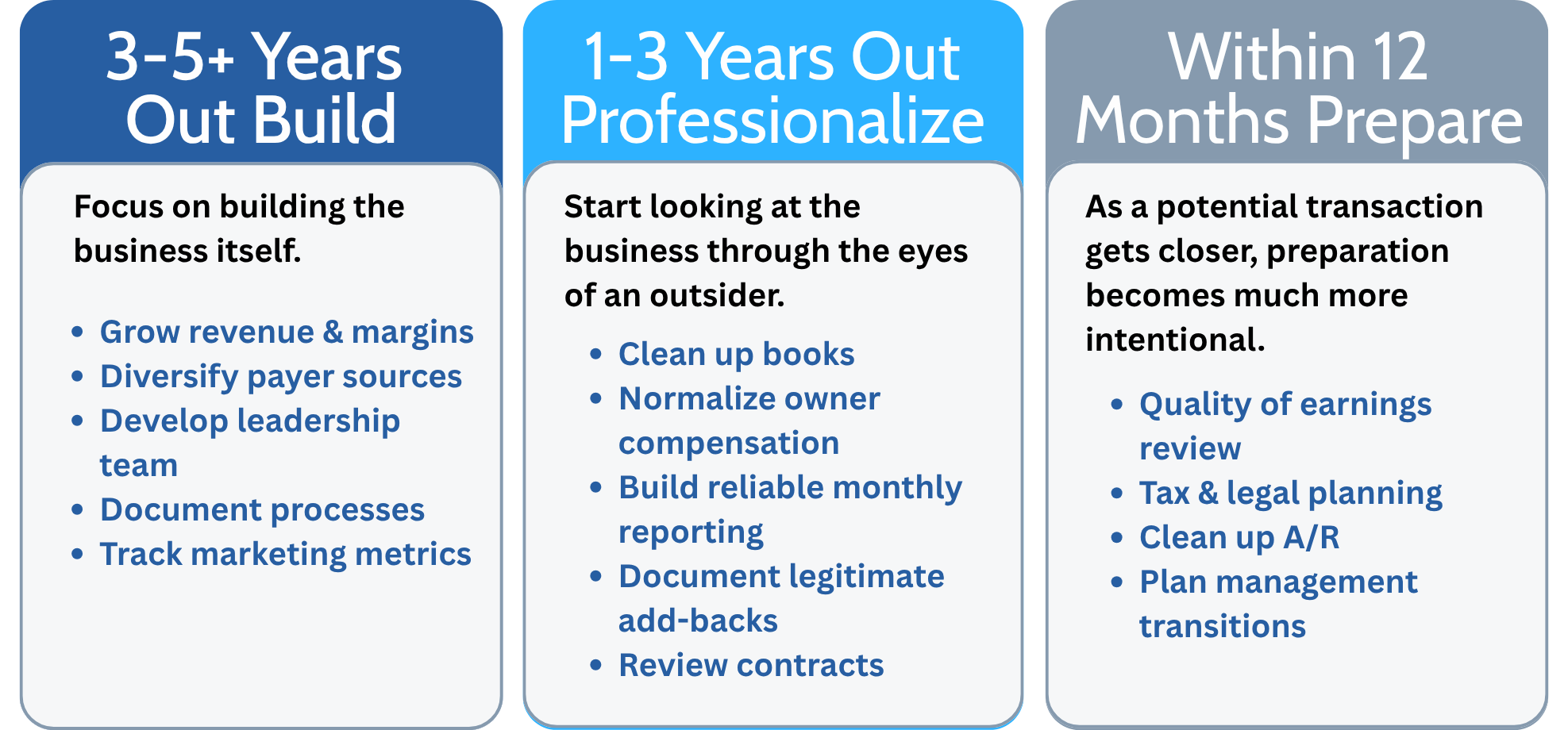
3–5+ Years Out: Build
Focus on building the business itself.
Grow revenue and margins. Diversify payer sources. Develop your leadership team. Document processes. Track marketing metrics. Increase penetration in your territory.
Most importantly, start removing yourself as the bottleneck.
1–3 Years Out: Professionalize
Start looking at the business through the eyes of an outsider.
Clean up the books. Separate personal expenses. Normalize owner compensation. Build reliable monthly reporting. Document legitimate add-backs. Review contracts and franchise transfer requirements.
This is also a good time to get a rough idea of what your agency may be worth and monitor whether the underlying financial performance is improving.
Within 12 Months: Prepare
As a potential transaction gets closer, preparation becomes much more intentional.
That may include:
A Quality of Earnings-style financial review
Building a data room
Tax planning
Legal cleanup
Reviewing employment agreements
Analyzing payer and client concentration
Cleaning up old accounts receivable
Planning management transitions
Understanding franchisor requirements
Engaging the appropriate CPA, attorney, broker, or transaction advisor
At this stage, surprises become expensive.
Finding them early gives you more time to address them.
Your Sale Price Isn't the Same as Your Take-Home Proceeds
If someone offers $4 million for your agency, that doesn't necessarily mean $4 million hits your bank account.

Depending on the transaction, you may need to account for:
Debt payoff
Broker or transaction fees
Attorney fees
Accounting and Quality of Earnings work
Franchise transfer costs
Taxes
Working-capital adjustments
Escrows or holdbacks
Seller financing
Earnouts
So don't focus exclusively on the headline purchase price.
The structure of the deal matters too.
For franchise owners, there's another layer. You're not simply selling a business. The buyer may also need to enter into a relationship with the franchisor, making transfer provisions, approval requirements, training, fees, territory rights, and franchise agreement terms important parts of the planning process.
The financial side of a transaction can become complicated quickly, which is why the right CPA, attorney, broker, and transaction advisors can be important when an actual sale is approaching.
The Bigger Picture
You don't have to be preparing to sell to start improving these areas.
Knowing your margins, cash flow, normalized ODP, payer concentration, owner dependency, and growth pipeline gives you a clearer picture of the business you're building today—and the options you'll have tomorrow.
Everything that makes your agency easier to sell also tends to make it a better agency to own.
More profitable.
More predictable.
Less dependent on the owner.
More scalable.
And ultimately, more valuable.
Frequently Asked Questions
-
The value of a home care agency depends on several factors, including normalized earnings, profitability, revenue quality, growth, payer concentration, owner involvement, market opportunity, and transaction structure. There is no single formula that applies to every agency.
-
There is no universal valuation multiple for home care agencies. Revenue and normalized earnings multiples can vary based on the size and financial performance of the agency, growth, risk, market conditions, owner dependency, payer mix, and deal structure.
-
Improving sustainable profitability, diversifying revenue, reducing owner dependency, maintaining accurate financial reporting, strengthening the marketing pipeline, and building reliable operational systems can all contribute to a stronger and more valuable business.
-
Revenue is an important consideration, but it is only one part of valuation. Buyers may also look closely at profitability, cash flow, growth, revenue concentration, management, owner involvement, market opportunity, and the sustainability of the business.
-
Yes. Understanding the factors that influence your agency's value can help you identify opportunities to improve profitability, reduce risk, strengthen operations, and build a more valuable business—even if you never plan to sell.
Do You Know What Your Agency's Numbers Say About Its Value?

At Sourced, we have extensive experience supporting in-home care businesses, helping owners understand the financial side of their agencies—from bookkeeping and billing to financial reporting, profitability, forecasting, and CFO-level analysis.
We're not business brokers, and our job isn't to sell your agency.
Our job is to help you understand the numbers behind it.
If you'd like to talk through your agency's financials, normalized ODP, margins, or the factors that may influence its value, schedule a free discovery call with the Sourced team.

— Brad Wolfe, Owner, Sourced Bookkeeping & Consulting
Continue Reading:
If you found this article helpful, you may also enjoy:
Have questions? Fill out our contact form and a representative will contact you shortly:
Want more insights like this for home care agency owners?
Join our mailing list to receive practical financial and operational tips specifically for the in-home care industry.
About Sourced
Sourced is a financial and accounting firm that helps business owners gain clarity, improve financial performance, and make more confident decisions.
Our team provides:
Sourced also brings specialized expertise to the in-home care industry, supporting 175+ agencies across the country and helping bill over $500M in care annually. That experience gives our team a unique perspective on the financial and operational factors that drive successful home care businesses.
Like us on social media or subscribe to stay updated!
